Why the Same Outfit Reads Completely Differently With a Two-Inch Shoe Change
Quick Answer: Shoe height changes where every hem lands relative to your leg, and hem position is what the eye reads as proportion. A two-inch heel does not only make you taller - it shortens the visible gap between hem and floor, moves the trouser break, and shifts the ratio between your upper and lower body. The practical rule is to decide the shoe first and hem to it, or to own one pair of trousers hemmed for flats and one for heels.
The outfit looked great in the shop and wrong at home. You are wearing different shoes.
That is almost always the answer, and it is the cheapest styling fix there is.
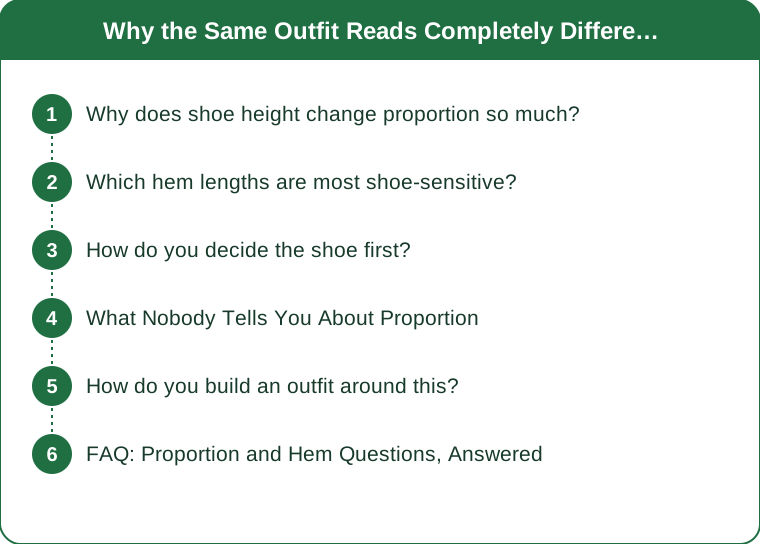
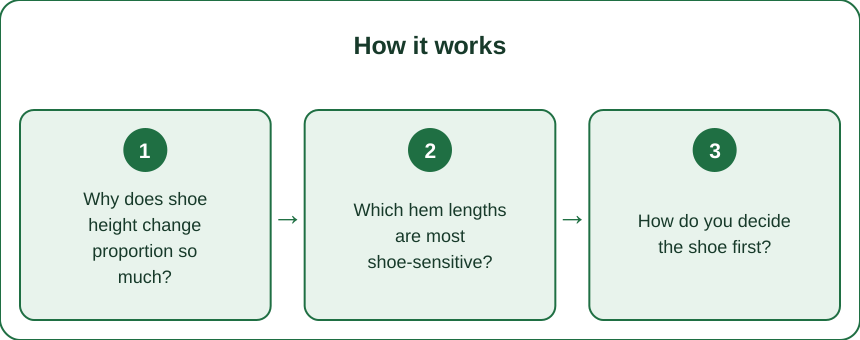
Why does shoe height change proportion so much?
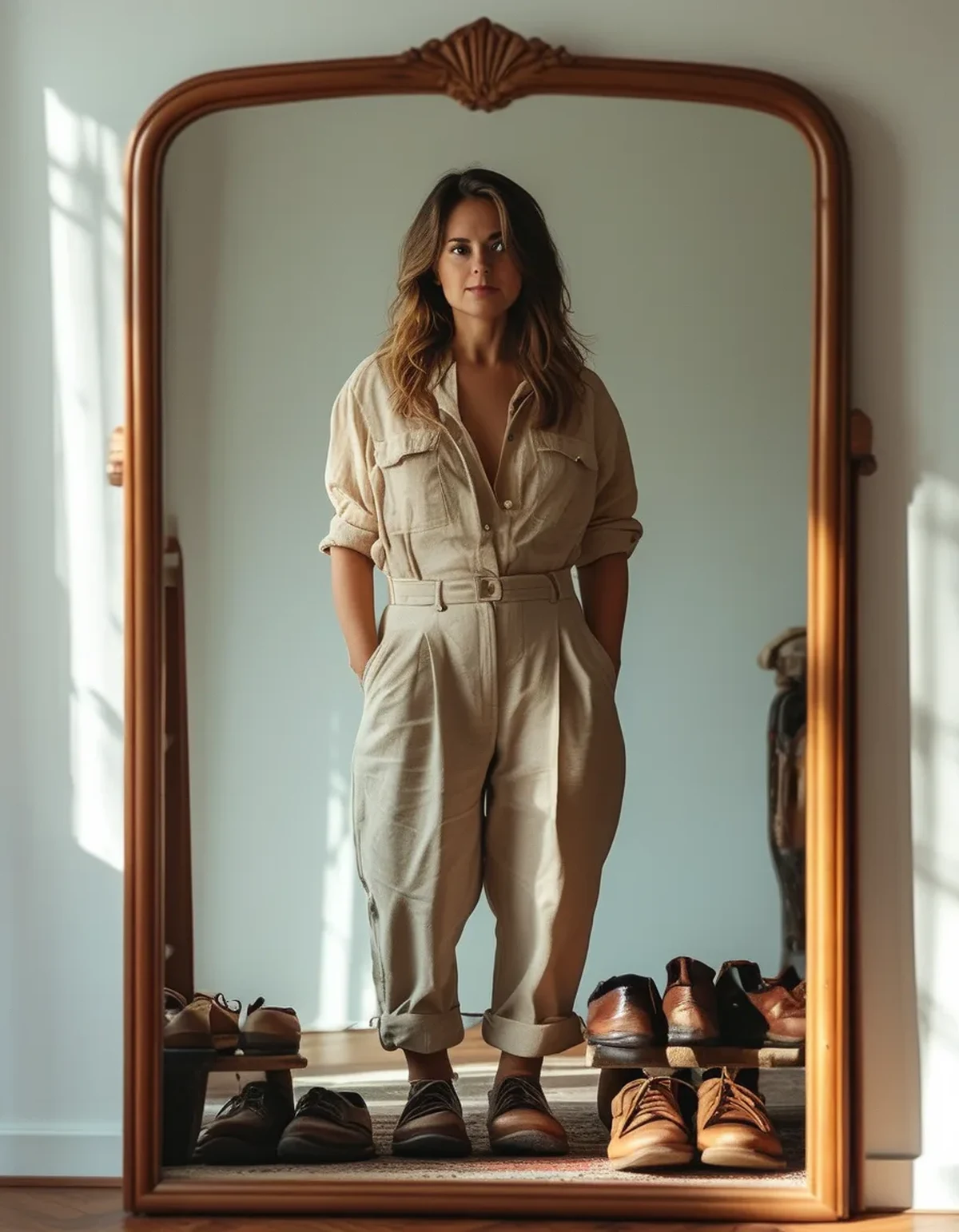
Every hem is measured from the floor, and the shoe moves the floor. A two-inch heel effectively raises the hem two inches relative to your foot.
Trousers hemmed for heels puddle badly in flats, and trousers hemmed for flats sit awkwardly short in heels. The same garment is genuinely two different garments.
The eye reads proportion as ratios between visible segments - shoulder to waist, waist to hem, hem to floor. Changing one changes the perception of all of them.
A heel also changes posture, tilting the pelvis slightly and altering how a garment hangs, which compounds the length effect.
Ankle exposure is a specific and powerful variable. A visible ankle reads as a break in the leg line and creates a longer-looking leg above it, which is why cropped trousers with a low-vamp shoe work so well.
And the shoe’s vamp height - how much of the foot it covers - matters as much as its heel. A high-vamp shoe visually shortens the leg by ending the line earlier, which is why a pointed low-cut flat elongates more than a chunky loafer at the same height.
Which hem lengths are most shoe-sensitive?
Full-length trousers are the most sensitive of all, because their whole effect depends on the break at the shoe.
Cropped trousers and ankle lengths are the most forgiving, since they clear the shoe entirely and the relationship stops mattering.
Midi skirts are extremely sensitive - a midi that hits the widest part of the calf shortens the leg, and a two-inch heel can move it to a narrower point and transform the whole outfit.
Wide-leg trousers need the most precise hem of anything, because there is more fabric to puddle and the drape depends on the hem being right.
Maxi lengths need to clear the ground by the shoe height - about half an inch of clearance for the shoe you will actually wear.
And short lengths above the knee are the least affected, since they are nowhere near the shoe and the ratio does not depend on it.
How do you decide the shoe first?
Hem trousers to the shoe you will wear with them 80 percent of the time, not to your tallest heel or your flattest flat.
Own two pairs of your favourite trouser cut, hemmed differently, if you genuinely alternate. This is what people who look consistently good actually do.
Take the shoes to the tailor. Hemming without the shoes present is guessing, and it is the most common reason a good alteration lands wrong.
For wide-leg trousers, aim for a hem that just grazes the top of the shoe - about half an inch off the floor for flats, adjusted for heels.
For straight-leg trousers, a slight break or no break both work, and no break reads more contemporary and elongates more.
Cuffing is the free adjustment. A single clean cuff shortens a trouser by an inch or two and works with a lower shoe.
And for anything you are unsure about, take a photo in a full-length mirror. Proportion is far easier to judge in a photograph than in a mirror, because the mirror invites you to look at your face.

What Nobody Tells You About Proportion
The waistline placement does more than the shoe does. A high-rise trouser moves the visual waist up and lengthens everything below it, and this is a larger effect than two inches of heel. If you only change one thing, change the rise.
Vertical continuity beats vertical lines. A monochrome column - trouser and shoe in the same tone - lengthens the leg far more effectively than a pinstripe. Matching the shoe to the trouser is the single most reliable proportion trick.
Contrast at the ankle shortens the leg, which is why a dark trouser with a white sneaker reads shorter than the same trouser with a dark shoe. Sometimes that is the effect you want; it should be a choice.
The widest point of a garment sets the perceived width of the body at that height, which is why a midi skirt hem placement matters as much as its length.
Tucking is a proportion tool, not a formality decision. A front tuck moves the visual waist without committing to a full tuck, and it is the most useful three-second adjustment in styling.
Jacket hem placement relative to the hip is its own variable, and a jacket ending at the widest part of the hip is doing the same thing a bad midi hem does.
And nearly all of this is about where the eye stops. Proportion is a set of decisions about which horizontal lines you create and where you put them - nothing more mystical than that.
How do you build an outfit around this?
Start from the shoe if the shoe is fixed - a work requirement, walking distance, the weather.
Set the waistline next, since it does the most work.
Then choose the hem that suits the shoe, cropping or cuffing as needed.
Then decide where the top ends relative to the waist - tucked, front-tucked or ending at the hip, and check that it is not landing at your widest point.
Match the shoe tone to the trouser tone if you want maximum length, or contrast deliberately if you want the outfit broken up.
Photograph it once and look at the photo rather than the mirror.
And keep a note of which trousers are hemmed for which shoes, which sounds excessive and saves the recurring five minutes of confusion in front of the wardrobe.
FAQ: Proportion and Hem Questions, Answered
How long should trousers be?
It depends entirely on the shoe. For flats, roughly half an inch off the floor; for heels, hemmed with the heels on. Take the shoes to the tailor rather than guessing.
Should I hem for heels or flats?
For the shoe you will actually wear most often with those trousers. If you genuinely alternate, two pairs hemmed differently is the real answer.
Why does the same midi skirt look different with different shoes?
Because the shoe changes where the hem sits relative to your calf. A hem at the widest part of the calf shortens the leg; two inches of heel can move it to a narrower point.
What is the single most effective proportion trick?
Matching the shoe tone to the trouser tone, creating an unbroken vertical column. It outperforms every other adjustment for apparent leg length.
Does rise matter more than shoe height?
Yes. Moving the visual waistline changes proportion more than two inches of heel does, and it works regardless of what is on your feet.
How do I judge proportion accurately?
Take a full-length photo. Mirrors invite you to look at your face; photographs let you see the horizontal lines, which is what proportion actually is.
TL;DR:
- Shoe height moves the floor, and every hem is measured from the floor - the garment is genuinely different with different shoes.
- Full-length trousers and midi skirts are the most shoe-sensitive lengths; cropped and above-knee are the least.
- Hem to the shoe you wear 80 percent of the time, and take the shoes to the tailor.
- Rise does more for proportion than heel height does - move the visual waist first.
- Matching shoe tone to trouser tone creates an unbroken column and is the most reliable length trick there is.
- Contrast at the ankle shortens the leg; make it a choice rather than an accident.
Photograph the outfit. Proportion is much easier to see in a photo than in a mirror.
See It in Motion
Seen here: High Waist Wide Leg Yoga Pants with Pockets — shop it on bubblelime.com
Keep Reading
This article is for general informational and styling purposes only. Fit, sizing, and product availability may vary.