Why Your Hair Length Changes Outfit Proportion More Than Your Shoes
Quick Answer: Your hair is a large, dark or light shape sitting at the very top of your silhouette, and the eye reads the whole vertical line as one thing. Hair that ends at the bust creates a visual break there; an updo removes the break and lengthens the neck; long hair down narrows the shoulders. Because the break sits high in the frame, moving it changes the proportion of everything below it — which is why shoes, sitting at the far end, matter less than people assume.
If an outfit stopped working and you cannot say why, check what your hair was doing the last time it did.
It is the variable nobody writes down.
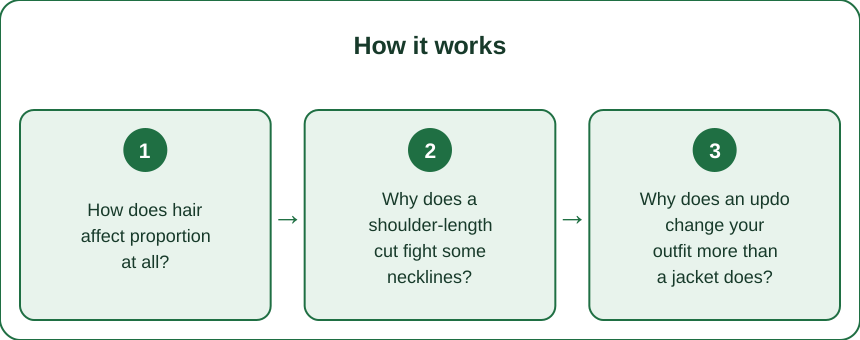
How does hair affect proportion at all?
By adding or removing a horizontal break near the top of the silhouette.
When someone looks at you, the eye travels the vertical line from head to feet and registers where that line is interrupted. Every interruption divides the body into sections, and the relative size of those sections is what we call proportion.
Hair creates one of the strongest interruptions available, for two reasons. It is usually high contrast against skin and often against clothing, and it sits at the top of the frame, where the eye starts. A break created early in the sequence sets the scale for everything after it.
So hair that ends at the collarbone puts a line at the collarbone. Hair that ends at the bust puts a line at the bust — one of the least flattering places to add a horizontal, because it widens the torso at its widest point and shortens the apparent leg line by making the upper body read longer.
Shoes, by contrast, sit at the very end of the sequence. By the time the eye reaches them, the proportions have already been decided.
Why does a shoulder-length cut fight some necklines?
Because two nearly parallel horizontals sitting close together look like a mistake, exactly as two near-matching colours do.
A blunt shoulder-length cut creates a strong horizontal at the shoulder or just below. Put a boat neck or a wide scoop at almost the same height and you have two lines a few centimetres apart, competing. The eye cannot decide which one is the shape, and the result reads busy and slightly off, without anything being obviously wrong.
The same cut with a V-neck looks completely different — the V runs at an angle to the hair’s horizontal, the lines cross rather than compete, and the neck appears longer.
Reliable pairings:
- Blunt shoulder-length hair: V-necks, open collars, anything with a vertical or diagonal
- Long layered hair: most necklines, because layers soften the horizontal into a gradient
- Very short hair: high necks and turtlenecks work beautifully, since there is no competing line
- Bob at the jaw: avoid a strong horizontal at the collarbone; a slight scoop or V works better
It is not that some necklines are wrong. It is that they were chosen when your hair ended somewhere else.
Why does an updo change your outfit more than a jacket does?
Because it removes a break instead of adding one, and removal is the more dramatic move.
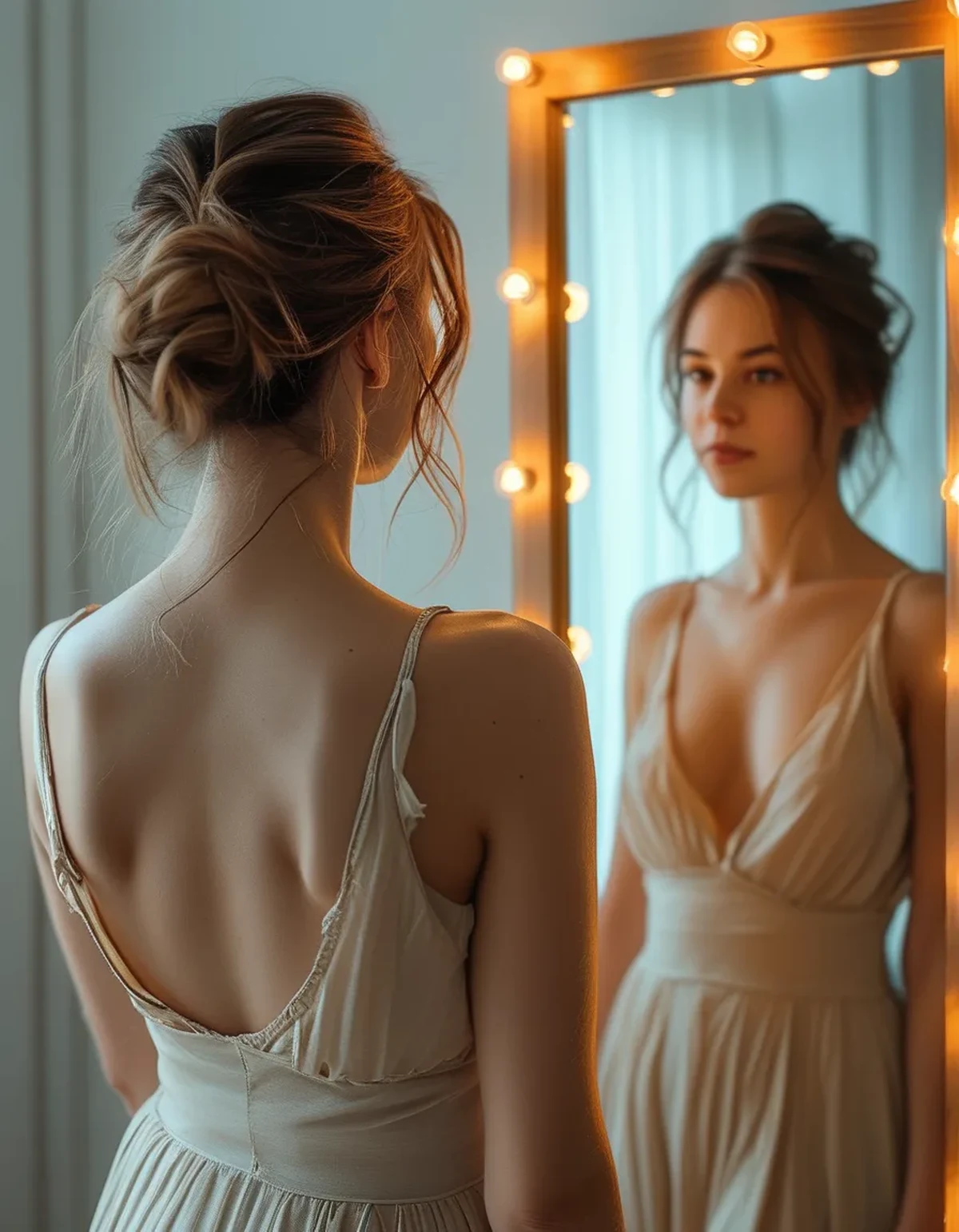
Adding a jacket introduces a new vertical line and some structure at the shoulders. Useful, but incremental. Putting your hair up deletes an entire horizontal from the silhouette and exposes the full length of the neck, which extends the unbroken vertical from the top of the head down to the neckline.
The practical effects are consistent:
- The neck reads longer, sometimes dramatically
- The shoulders read wider, because they are no longer partly covered
- The whole figure reads taller, since the top section of the silhouette got longer without anything else changing
- Earrings and necklines suddenly become visible and start doing work
This is why the same dress can look casual with hair down and formal with hair up, without a single change to the clothing. And it is why an outfit that felt unbalanced sometimes just needs your hair off your shoulders rather than a different top.
It is a genuinely free styling lever, and it is the fastest one available.
What Nobody Tells You About Hair and Outfit Proportion
Hair volume matters as much as hair length. A voluminous style widens the head, and a wider head makes the shoulders read narrower and the body read smaller by comparison. Flat hair does the reverse. Two people with identical haircuts and different volume have genuinely different proportions to work with.
Colour contrast changes the strength of the break. Dark hair against a pale top creates a hard line. Blonde hair against a cream top creates almost none. This is why the same haircut can be a proportion problem in one outfit and a non-issue in another — you did not change the hair, you changed how visible its edge was.
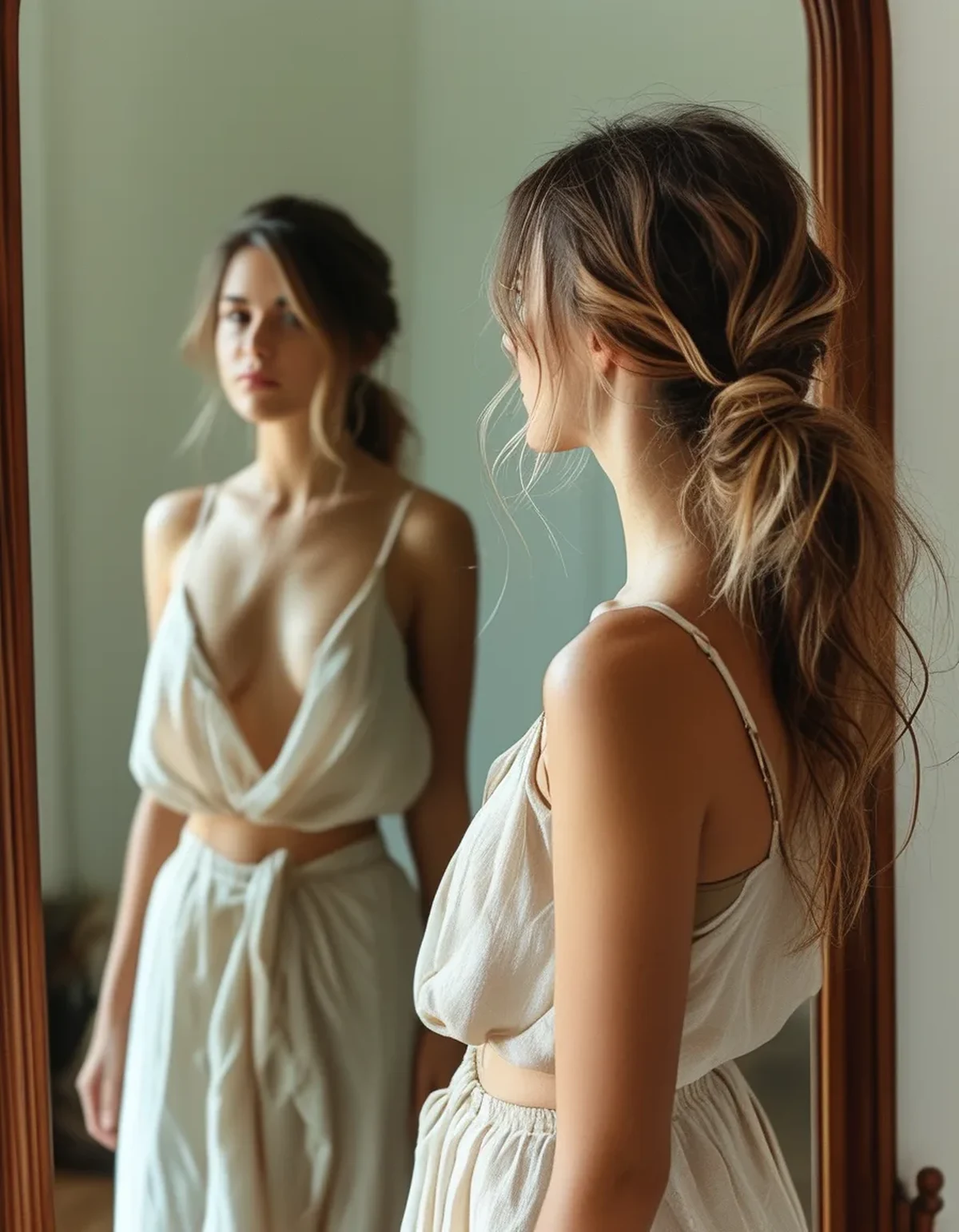
And the thing that catches people out: hair moves. You dressed in front of a mirror with your hair sitting one way, and by the afternoon it is behind your shoulders, or half of it is. The outfit you checked and the outfit you are wearing are not the same silhouette. If a look only works with hair arranged precisely, it is a fragile look — and fragile looks are the ones you remember feeling uncomfortable in.
How to style around your current length
Work with the break where it currently is.
If your hair ends at the bust, you have a horizontal at the widest part of the torso. Counter it with a vertical: an open shirt or cardigan worn undone, a long necklace, a front zip, or a centre-front seam. Or move the break by tucking hair behind one shoulder — asymmetry reads as intentional and softens the line.
If your hair ends at the collarbone, you are in the easiest position. Almost anything works. Take advantage of it with wider necklines you could not wear at other lengths.
If your hair is very long, it creates a long vertical frame on both sides of the torso, which narrows the body but can also swallow a top. Half-up styles restore the shoulder line without losing the length.
If your hair is short, the neck and shoulders are fully exposed and the outfit’s neckline does all the work. This is the length where collars, high necks, and shoulder detail earn the most.
One quick test: take a photo of the outfit with hair down and hair up. Choose from the photos, not the mirror. The camera flattens you into the same two dimensions everyone else sees, and the proportion difference is far more obvious there than it is live.
FAQ: Hair and Proportion Questions, Answered
Should I plan outfits around a haircut or the other way round?
Around the haircut, since it changes far less often. If you are considering a significant cut, spend a minute thinking about which necklines you actually wear — a blunt bob and a wardrobe of boat necks is a fixable problem, but it is easier to know beforehand.
Does hair colour change proportion or just contrast?
Contrast, which then changes how strong the proportion break reads. Going lighter softens the edge between hair and skin and makes the break less pronounced. Going darker sharpens it. Neither is better; they just give you a different tool.
Why does my outfit look different in photos than in the mirror?
Partly because mirrors are reversed and partly because you look at yourself in a mirror in pieces, rather than as a whole shape. Hair proportion is a whole-shape effect, so it shows up in photographs far more clearly than in a mirror. Photograph the outfits you are unsure about.
TL;DR:
- Hair creates a strong horizontal break near the top of the silhouette, where the eye starts
- Hair ending at the bust widens the torso and shortens the apparent leg line
- Putting hair up removes a break entirely, lengthening the neck and the whole figure
- Volume and colour contrast change how strongly that break reads
- Photograph outfits with hair up and down — the difference is obvious in a photo and invisible in a mirror
Before you decide an outfit does not work, try it with your hair up. It costs ten seconds, it is the single largest free change available to you, and it explains a surprising number of the outfits sitting unworn in your wardrobe.
Keep Reading
This article is for general informational and styling purposes only. Fit, sizing, and product availability may vary.