Why Fabric Weight Changes Proportion More Than the Cut Does
Quick Answer: Fabric weight determines how a garment hangs, and how it hangs determines the vertical lines your eye follows. A heavier fabric falls in long unbroken lines from the widest point, which reads as length. A lighter fabric follows the body’s curves and breaks into horizontal folds, which reads as width. Two garments in the same cut can therefore produce opposite proportional effects, and the fabric is doing more of the work than the pattern.
This is why the same style number in two materials fits identically and looks nothing alike.
What does fabric weight actually change?
Where the fabric stops touching your body.
A garment hangs from its highest point of contact — the shoulder for a top, the waist or hip for a bottom. From there, the fabric either drapes away from the body in a straight fall or follows the body’s contour.
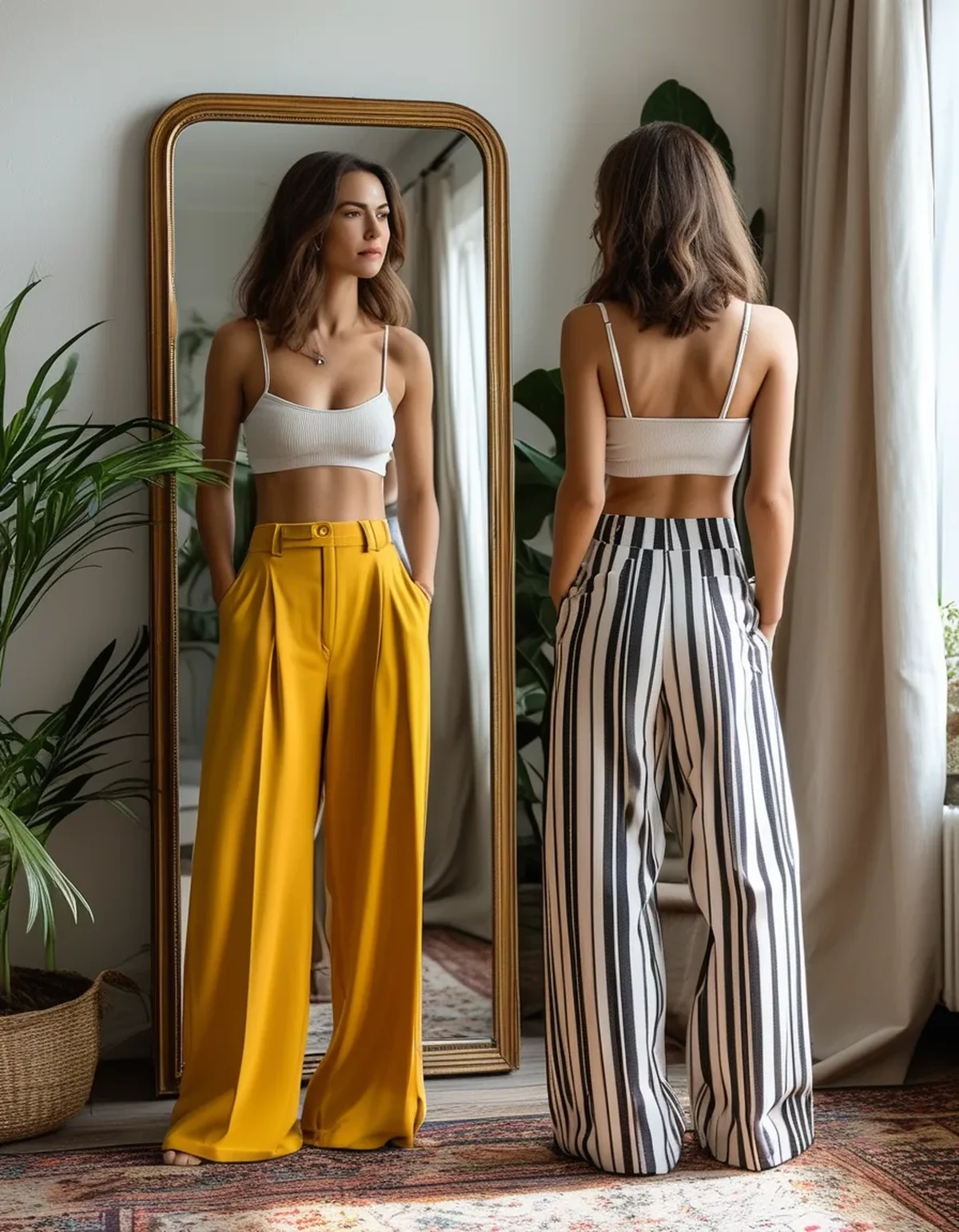
Heavier fabrics have enough mass to overcome the friction and static that would otherwise hold them against you. They fall from the widest point they touch and hang plumb from there. A heavy crepe trouser hangs from the hip in a single vertical line to the hem, and everything between hip and ankle is a straight uninterrupted plane.
Lighter fabrics do not have the mass to fall away. They follow the thigh, cling slightly, and then move when you move, creating small horizontal folds at every point where the body changes direction — hip, thigh, knee.
The visual result is that the heavy fabric gives your eye one long vertical to travel, and the light fabric gives it a series of short interrupted segments. Your eye reads a continuous vertical line as length and an interrupted one as width, which is the entire mechanism.
This applies to tops too. A heavy knit falls from the shoulder and bust in a straight line; a fine jersey traces the waist and creates a horizontal at the narrowest point. Neither is better — they produce different proportions from the same pattern, and the choice depends on what you want to emphasize.
Why do stylists talk about drape rather than weight?
Because weight alone does not predict behavior, and drape is the property that actually matters.
Drape is how a fabric falls under its own weight, and it depends on weight, fiber, weave structure, and finish together. A heavy stiff canvas and a heavy fluid crepe weigh similarly and behave nothing alike. The canvas holds a shape away from the body; the crepe pours.
The useful distinctions in practice:
Heavy and fluid — wool crepe, heavy viscose, silk crepe, tencel twill. These are the proportion-lengthening fabrics. They fall straight, ignore the body’s contour, and create long lines.
Heavy and stiff — denim, canvas, structured cotton, ponte. These hold their own architecture. They create proportion through the shape of the garment rather than through drape, and they will maintain a wide leg as wide whether or not that suits you.
Light and fluid — chiffon, fine silk, lightweight rayon. These move constantly, follow the body, and create the most horizontal interruption. Excellent for movement and softness; the least lengthening.
Light and stiff — cotton poplin, taffeta, organza. These stand slightly away from the body and hold crisp folds, which reads as volume rather than length.
The single most useful test in a shop takes three seconds: hold the fabric up by one point and let it hang. If it falls into a narrow column, it will lengthen. If it spreads into a cone or wrinkles into folds, it will add width. This tells you more about how the garment will read than trying it on in poor lighting does.
Myth vs Fact: Fabric and Proportion
Myth: A wide-leg trouser always shortens the leg. Fact: In a heavy fluid fabric, a wide leg falls in a straight column from hip to floor and is one of the most lengthening shapes available. In a light fabric, the same wide leg collapses inward and does shorten. The shape is not the variable — the drape is.
Myth: Thin fabric is more flattering because it is less bulky. Fact: Thin fabric shows more, follows more, and interrupts more. Bulk is not the enemy of a long line; clinging is. A slightly heavier fabric almost always reads cleaner.
Myth: Stretch improves fit and therefore proportion. Fact: Stretch improves comfort and usually worsens the vertical line, because a stretch fabric conforms to the body’s contour rather than hanging past it. This is the trade-off in most modern trousers, and it is why the same cut in a rigid fabric often looks longer.
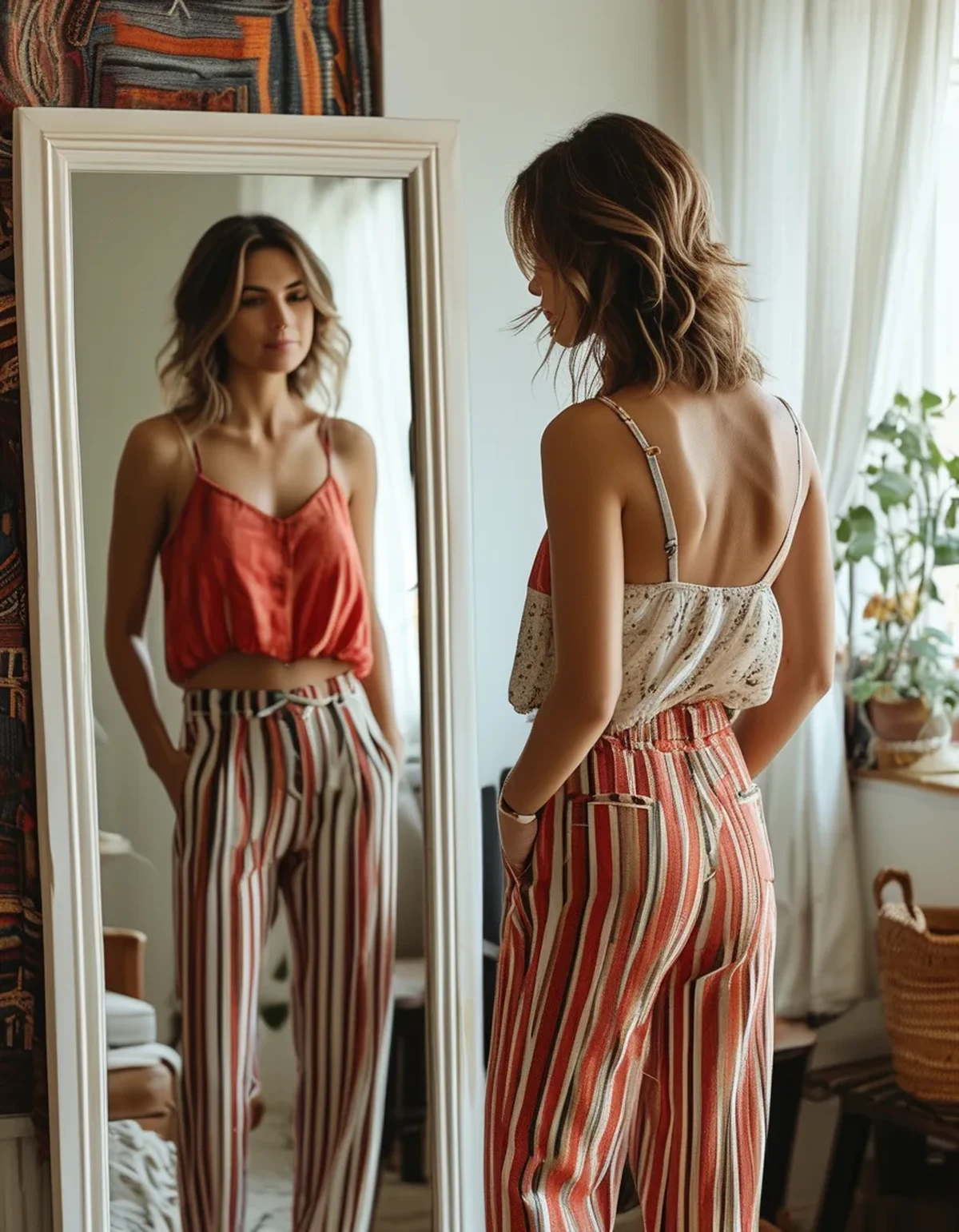
Myth: Vertical stripes lengthen regardless of fabric. Fact: A vertical stripe on a fabric that clings and folds becomes a wavy, broken line, which does nothing. The stripe only lengthens if the fabric hangs straight enough for the stripe to stay straight.
Myth: Heavier fabric is always better quality. Fact: Weight and quality are unrelated. A fine high-quality silk is very light. Weight is a design choice with a specific visual consequence, not a quality marker.
Myth: You can fix a light fabric with tailoring. Fact: Tailoring changes fit, and drape is a material property. A light fabric taken in still follows the body. This is why alterations sometimes fail to produce the effect people expected.
How do you use this when the seasons shift?
By treating the seasonal fabric change as a proportion change, which it is.
Every autumn, wardrobes move from light to heavy fabrics, and most people experience this as a temperature adjustment. It is also a substantial shift in how their proportions read.
The immediate effect: autumn fabrics lengthen. Heavier wools, denser knits, and structured cottons all fall straighter than their summer counterparts. Outfits that felt short in July often read longer in October in a comparable silhouette.
The transition period is where it goes wrong. Late August into September is when people layer a heavy piece over a light one, and that combination is the least predictable. A heavy jacket over a fluid dress creates a hard horizontal at the jacket hem, dividing the body at whatever point the jacket ends, while the dress below continues to follow the body. That is two different drape behaviors in one outfit and it rarely reads well by accident.
The practical rules for the transition:
Match drape families where possible. A fluid top over a fluid bottom, or a structured top over a structured bottom, reads more coherently than mixing.
If you mix, let the heavier piece be the outer layer and end at a point you have chosen. The hem of the structured piece becomes the strongest horizontal in the outfit, so put it where you want the eye to divide — usually at the narrowest point of your torso or well below the hip, not at the widest point.
Reassess the summer pieces you are carrying into autumn. A light dress that worked with sandals in a straight line frequently stops working with boots and a jacket, and the reason is almost always the drape mismatch rather than the color.
Buy the transitional pieces in mid-weight fluid fabrics. They are the most versatile, they layer under and over, and they are the most reliably lengthening category.
FAQ: Fabric and Proportion Questions, Answered
How do I judge fabric weight when shopping online?
Look for a stated GSM or fabric weight where available, and read the fiber content. Viscose, tencel, and crepe descriptions suggest fluidity; poplin, canvas, and ponte suggest structure. Photographs of the garment in motion tell you more than flat product shots.
Does lining change drape?
Substantially. A lining adds weight and separates the outer fabric from your body, which usually improves the hang of a light fabric. An unlined light trouser and a lined one in the same fabric are different garments proportionally.
What is the single most versatile fabric weight?
A mid-weight fluid fabric — something with enough mass to hang straight but light enough to move. It works across seasons, layers in both directions, and produces the long line most people are looking for without the stiffness of a heavy structured cloth.
TL;DR:
- Fabric weight decides whether a garment hangs in one long vertical line or follows the body in interrupted segments.
- Continuous vertical lines read as length; interrupted ones read as width, which is why identical cuts look different.
- Drape, not weight alone, is the property that matters — heavy fluid lengthens, light fluid clings, stiff creates volume.
- Match drape families when layering, and place the structured piece’s hem deliberately.
Hold the fabric up by one point next time you shop. How it falls in that three seconds predicts more than the fit does.
See It in Motion
Seen here: High Waist Wide Leg Yoga Pants with Pockets — shop it on bubblelime.com
Keep Reading
This article is for general informational and styling purposes only. Fit, sizing, and product availability may vary.