Why Layering Changes Your Proportions More Than Any Single Piece
Quick Answer: A layer creates new horizontal lines at its hem, its opening, and its shoulder, and those lines override the ones underneath. An open jacket adds two strong vertical lines that lengthen; a closed one adds a horizontal at the hem that shortens. The layer’s hem position relative to your hip is the single most influential variable in the whole outfit.
You wore this exact combination all summer and it looked right. You add a jacket for the first cool morning and suddenly the proportions are off, the trousers look short, and you cannot work out why.
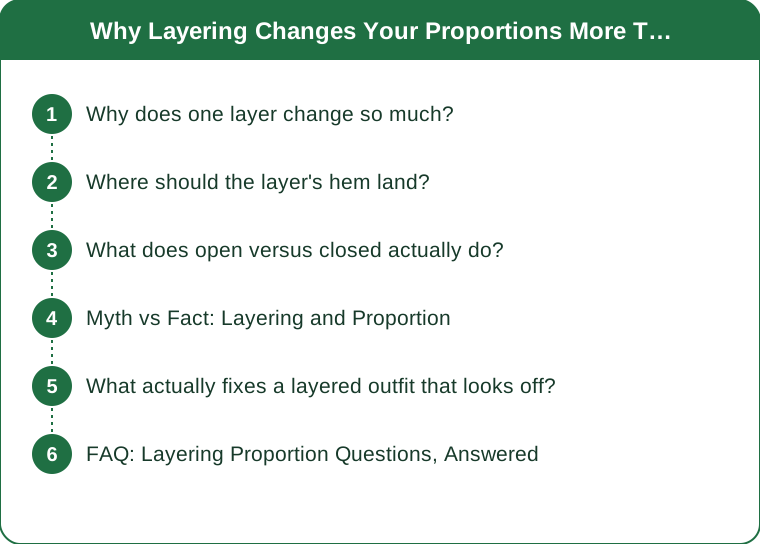
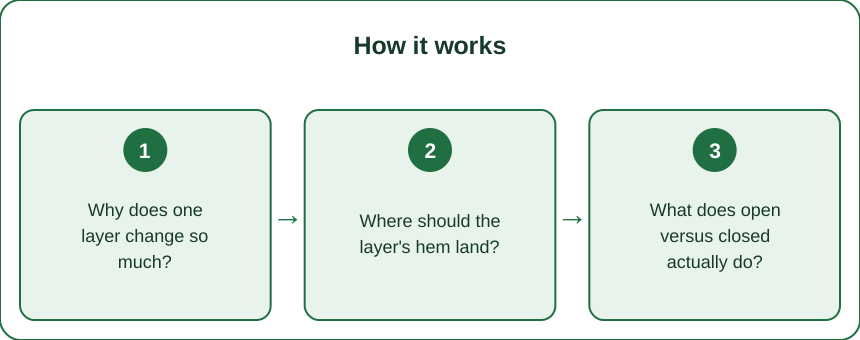
Why does one layer change so much?
Because the eye reads the outermost edge, and everything underneath becomes secondary.
Proportion in an outfit is mostly about where the horizontal breaks fall. Your waist, your hip, your hem — those lines divide the body into segments, and their relative sizes are what reads as balanced or not.
A layer adds new lines and hides old ones:
- A new horizontal at the layer’s hem, which is usually the strongest line in the whole outfit because it sits at the outer edge of the silhouette
- Two new verticals at the layer’s front opening, if it is worn open
- A new shoulder line, which is often wider than your own and changes the shoulder-to-hip ratio
- The concealment of the waist, which removes the line you were previously relying on
That last one is the one people miss. A high-waisted trouser does its lengthening work by putting a horizontal line high on the torso. Cover that line with an open cardigan and the effect is substantially reduced, even though nothing about the trousers changed.
Where should the layer’s hem land?
Not at your widest point, and not at your natural waist unless you want to emphasize it.
The general principles, which hold across most body shapes:
- Above the hip bone (cropped): creates a high horizontal, lengthens the leg line, emphasizes the waist. Works well with high-rise bottoms. Can shorten the torso visually, which is a problem if you have a short torso to begin with
- At the widest part of the hip: the least flattering placement for most people, because it draws a line exactly where you would rather not have one
- Just below the hip, at upper thigh: the safe default and the reason so many jackets are cut here. It clears the widest point and creates a leg line that starts below it
- Mid-thigh: balances well with slim bottoms, competes awkwardly with wide ones
- Below the knee: creates a long unbroken vertical, elegant with a narrow bottom, overwhelming with volume underneath
The rule that covers most cases: the layer hem and the widest point of your hip should not be at the same height. Everything else is preference.
Worth checking on your own jackets this week, since they are about to come out of storage. Two inches of hem difference between two jackets you own will produce visibly different outfits from the same base.
What does open versus closed actually do?
Almost opposite things, which is why the same jacket can read completely differently in two photos.
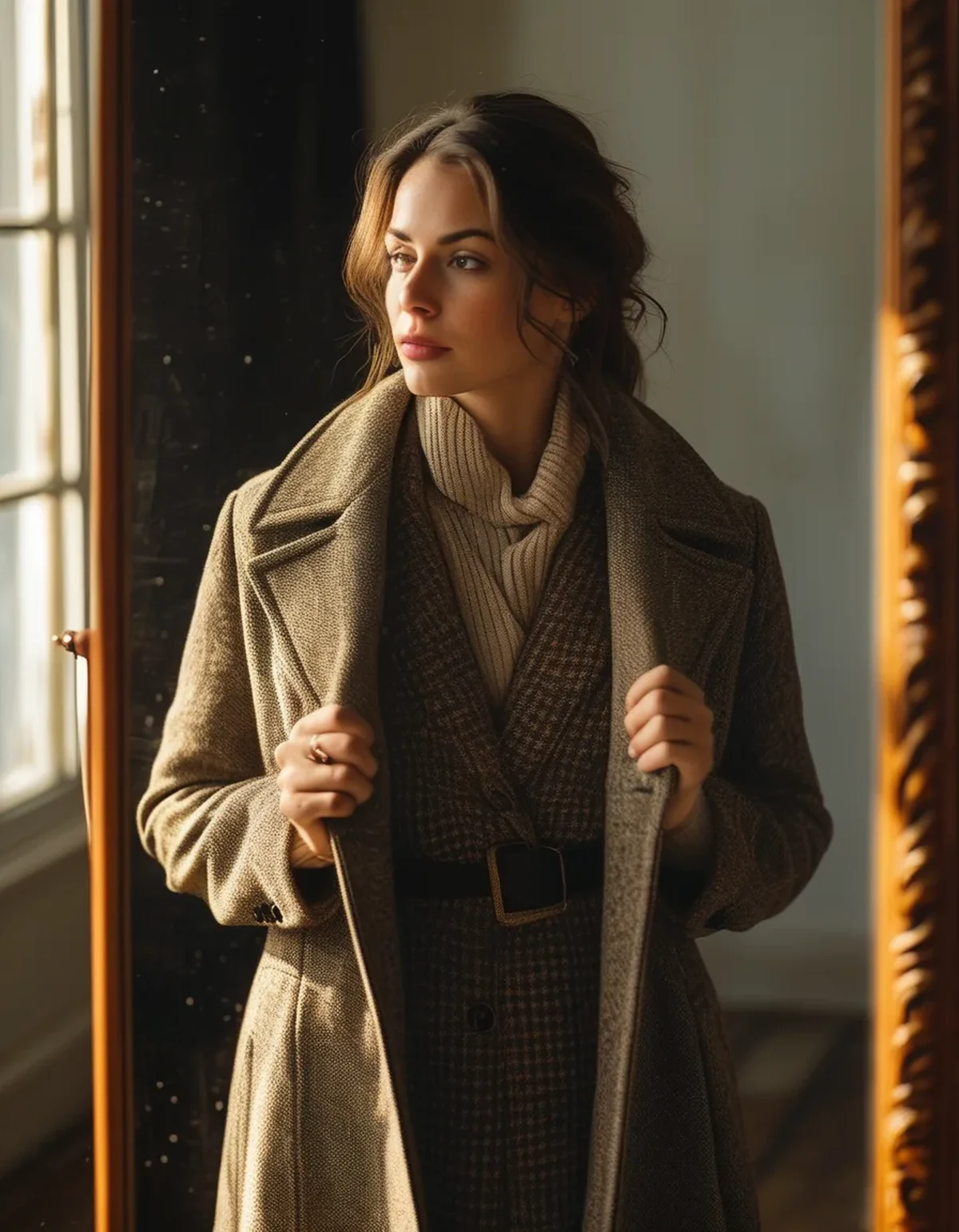
Open creates a long vertical column down the center of your body from shoulder to hem. Vertical lines lengthen. It also frames a narrow strip of whatever you are wearing underneath, which reads as narrower than the full width of that garment. This is why an open layer over a fitted top nearly always looks longer and leaner than the top alone.
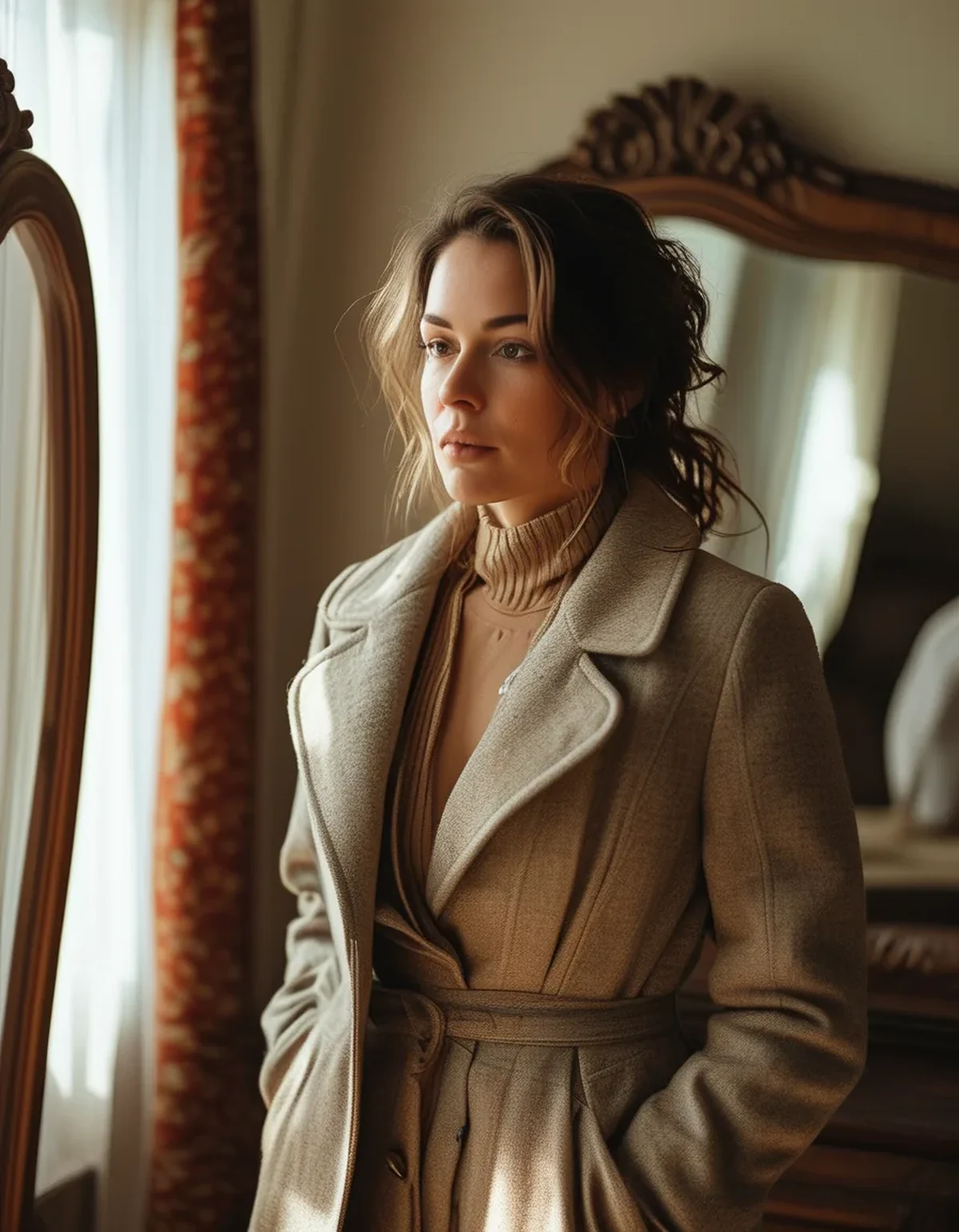
Closed creates one continuous surface with a strong horizontal at the hem. It hides the waist entirely and makes the silhouette read as a single block from shoulder to hem. It is not inherently worse — a closed layer with a defined waist or a belt can be excellent — but it needs its waist definition supplied deliberately, because the layer removed the one underneath.
The practical version:
- Want longer: wear it open, and pick something with a narrow front opening rather than a wide lapel
- Want more structure: wear it closed and belt it, or choose one that is shaped at the waist
- Avoid the in-between: a closed jacket with no waist definition and a hem at the hip is the combination that flattens most outfits, and it is the default state of most casual jackets
Myth vs Fact: Layering and Proportion
Myth: Layering makes everyone look bigger. Fact: Volume adds width, but an open layer’s verticals often produce a net lengthening. Whether you look bigger depends almost entirely on where the hem falls and whether it is open, not on the fact of the extra garment.
Myth: You should match the length of your layers. Fact: Deliberately different lengths create a stepped effect that reads as intentional and adds depth. What looks wrong is lengths that are almost the same — a top peeking out an inch below a jacket reads as an error rather than a choice. Either clearly longer or clearly shorter.
Myth: Dark layers always slim. Fact: Dark reduces the visibility of shape, which can help or hurt. A dark layer over a dark base creates one long column, which is genuinely lengthening. A dark layer over a light base creates a strong contrast at the opening, which is the most attention-drawing configuration available — useful when you want it, unhelpful when you do not.
Myth: Adding a layer means resizing everything underneath. Fact: The base rarely needs changing. What usually needs changing is the bottom half, because the new hem line has moved where your leg line appears to start — and this is the adjustment nobody makes.
What actually fixes a layered outfit that looks off?
Four adjustments in order of how much they change, so you can stop at the first one that works.
- Change the hem relationship. If the layer hem sits at your widest point, swap for a shorter or longer one. This is the biggest lever and the one most people never try, because they assume the problem is the trousers.
- Open or close it. Free, instant, and often the entire fix.
- Restore the waist line. If the layer covers your waist, put the line back — a belt over the layer, a half-tuck of the base visible at the opening, or a layer that is shaped rather than straight.
- Adjust the base hem. Only now. A full tuck, half tuck, or front tuck of the top underneath changes what shows in the opening, which changes the vertical strip the eye reads.
And the seasonal note: this is the exact moment of year when this becomes relevant again, because the layer is back and the summer outfits underneath have not changed. If a combination that worked in July looks wrong now, the layer moved a line — it is not the trousers, and it is very rarely you.
FAQ: Layering Proportion Questions, Answered
Does this apply the same way to petite and tall frames?
The principles hold; the measurements shift. On a shorter frame, every horizontal line matters more because there is less vertical space between them, so hem placement is more sensitive. On a taller frame there is more room for multiple lines before the outfit reads as busy.
What about layering two pieces over a base?
The outermost hem still dominates, but the inner layer’s hem now becomes a secondary line. Make it clearly different from the outer one — two inches apart reads as a mistake, five or more reads as deliberate.
Why does it look fine in the mirror and wrong in photos?
A mirror shows you at your own eye level; a photo is usually taken from someone else’s, often lower. A lower camera angle exaggerates horizontal lines below the waist, which is exactly where your layer hem is. If an outfit consistently photographs worse than it mirrors, the hem placement is the first thing to check.
TL;DR:
- The outermost hem is the strongest line in a layered outfit and overrides everything underneath
- Keep the layer hem away from the widest point of your hip; just below it is the reliable default
- Open adds lengthening verticals; closed adds a shortening horizontal and needs a belt to replace the waist
- Fix problems in order: hem relationship, open or closed, restore the waist, then adjust the base
The reason your summer outfits feel wrong this week is not that anything about them changed. You added one edge, and the eye now reads that edge first.
Keep Reading
This article is for general informational and styling purposes only. Fit, sizing, and product availability may vary.