Why the Gap Between Your Hem and Your Shoe Decides the Whole Leg Line
Quick Answer: The eye reads a leg as one continuous line until something interrupts it, and the hem-to-shoe zone is where the interruption happens or does not. Keep the values connected — hem meeting shoe, or hem and shoe in similar depth of color — and the line runs unbroken, which reads long. Insert a high-contrast band of skin, sock, or shoe at the ankle and the line breaks into segments, which reads shorter. Every length rule you have ever heard is a special case of this one principle.
Once you see the handoff, you can run it deliberately with the pants you already own.

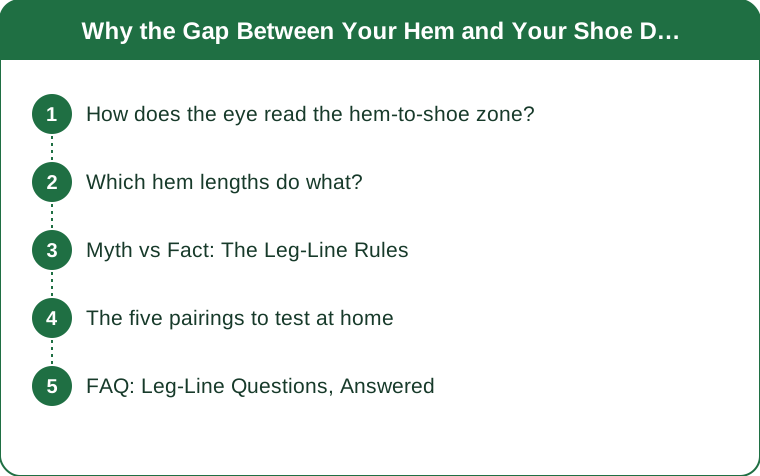
How does the eye read the hem-to-shoe zone?
As either a continuation or a border — and it decides in a glance.
Visual perception groups regions of similar value, meaning lightness and darkness, into single shapes. A dark pant flowing into a dark shoe forms one long shape from waist to floor; the leg reads as the full height of that shape. The same dark pant ending two inches above a white sneaker, with bright sock or skin between, forms three stacked shapes — pant, band, shoe — and the leg reads as the longest single segment, not the total.
Contrast is the scissors. Wherever the strongest value jump occurs, that is where the eye cuts the figure. Put the jump at the floor — dark hem, dark shoe, contrast only where shoe meets ground — and the cut happens below your feet, which is as long as a leg can read. Put the jump at the ankle and you have voluntarily cut yourself four inches shorter than the identical pants would otherwise allow.
This is why the same ankle-length pants can work brilliantly one day and oddly the next, with the only change being footwear. It is also why socks are secretly load-bearing: a sock matched to either the pant or the shoe extends one of them, bridging the gap, while a contrasting sock — the white gym sock between black hem and black sneaker — installs a hard border at the narrowest, most visible point of the leg.
Nothing about this requires height, or hides anything. It is simply choosing where the eye makes its cut.
Which hem lengths do what?
Each length is a different handoff problem, and each has a clean solution.
Full length, hem grazing the shoe. The unbroken maximum: the pant hands directly to the shoe with no gap at all. Bootcut leggings and flare leggings are this principle built into the garment — the hem breaks gently over the shoe and covers its top half, so pant and footwear merge into one column. This is the longest line available, and it is why the bootcut silhouette keeps returning for petite frames especially. The failure mode is excess: fabric pooling in folds at the floor reads as shortness at the other end of the leg.
Ankle crop, hem two to four inches above the shoe. Now there is a deliberate gap, and the gap shows the ankle — the narrowest point of the leg, which is exactly why the crop is flattering when the handoff cooperates. It wants a low-profile shoe with a low vamp — the vamp is where the shoe’s opening cuts across the foot — so the exposed skin runs long, from hem into the shoe. Chunky, high-collared sneakers eat the ankle and turn the crop into a stack of interruptions.
The 7/8 length. The compromise that dominates leggings for a reason: close enough to the shoe to keep the column nearly intact, cropped enough to show a sliver of ankle and stay clear of the floor. With a matched low sock, 7/8 leggings behave like full length; with a bare ankle and a low shoe, like a subtle crop.
Mid-calf. The honest difficulty: the hem lands at the widest visible point of the lower leg and installs its border there. Wearable — with the monochrome trick below — but it is the length working against the handoff rather than with it.

Myth vs Fact: The Leg-Line Rules
Myth: Nude shoes always lengthen the leg. Fact: Only nude-to-you shoes do — the effect depends on the shoe disappearing against your actual skin. A shade that matches someone else’s leg is just a beige shoe, and with dark pants a dark shoe extends the line further than any nude can.
Myth: Heels are the reliable lengthener. Fact: Height helps only if the line survives. A chunky heel with a high collar under cropped wide pants adds two inches of altitude and subtracts more in interruptions. A flat with a low vamp frequently out-lengthens a boot with a heel.
Myth: Tall women do not need any of this. Fact: Proportion is not height. A broken handoff shortens a 5’10” leg line exactly as it shortens a 5’2” one — it just starts from a longer baseline. The handoff also governs where the leg appears to begin and end, which is a balance question at every height.
Myth: Pointed toes are the only lengthening toe shape. Fact: The vamp matters more than the point. A low-cut almond or round toe that shows the top of the foot extends the line nearly as well; a high-vamp pointed flat gains little. The visible foot is functioning as extra leg.
Myth: Socks ruin cropped pants. Fact: Contrast socks cut the line; matched socks are a bridge. A sock in the pant’s color extends the hem downward, one in the shoe’s color raises the shoe upward — both preserve the column while keeping ankles warm once the weather turns.
The five pairings to test at home
Run these with what you own, two minutes at a mirror, and watch the same body change read.
One: bootcut over the shoe, values matched. Bootcut leggings or flares with a shoe of similar depth underneath, hem covering the shoe’s top half. The reference long line — use it as your baseline.
Two: 7/8 leggings, low sock, matched sneaker. The athleisure column: sock bridges hem to shoe, nothing interrupts. Compare against the same outfit with a white contrast sock and watch the cut appear.
Three: ankle crop, bare ankle, low-vamp flat. The deliberate gap done right — skin runs from hem into an open-topped shoe. Best in warm months and exactly the version late summer is built for.
Four: the monochrome column. One color family, or one value family, waist to floor — this is the trick that rescues difficult lengths, including mid-calf, because value continuity forgives border placement.
Five: your most-worn pants with your two most-worn shoes. Not a formula — an audit. One pairing will visibly out-perform the other, and now you will know why rather than just sensing it.
A seasonal note worth acting on now: sandal season handles the crop gap automatically, since open shoes barely register as interruptions. As sneakers and boots return over the next weeks, every cropped pant in the rotation needs its handoff renegotiated — the sock drawer becomes styling equipment, and hems that spent the summer effortless suddenly want the bridge.
FAQ: Leg-Line Questions, Answered
Do I have to match my shoes to my pants exactly?
No — value is what the eye groups, not precise color. Navy pants with near-black shoes read continuous; the pairing only breaks when lightness jumps, like black with white. Match depth, not swatches.
What are the cuffing rules for the line?
A cuff is a horizontal border, so it costs a little line wherever it sits — but a slim cuff that lands just above the shoe costs less than pooling fabric. Cuff to remove excess, keep it narrow, and keep the gap it creates small or bridged.
What happens when boot season arrives?
Boots are an opportunity: a hem that meets or slightly overlaps the boot shaft, in a similar value, builds the longest cold-weather line available — the boot becomes leg. The mistake is a gap between hem and shaft with contrast sock or skin flashing in it.
Does the same principle work with dresses and skirts?
Completely. The hemline is the border; whatever runs below it — tights, boots, bare leg, shoe — either continues the value or cuts it. A midi with matched tights and shoes reads column; the same midi over contrast ankle socks reads segments. The handoff is universal.
TL;DR:
- The eye cuts the figure at the strongest value jump; keep that jump at the floor and the leg reads its longest.
- Full-length and bootcut hems merge pant and shoe into one column; crops work when a low-vamp shoe lets skin run long; mid-calf fights the principle.
- Socks are styling equipment: matched socks bridge, contrast socks cut.
- Nude shoes, heels, and pointed toes are all special cases of the same rule — value continuity beats every individual trick.
Do the two-minute mirror audit tonight: your most-worn pants, both pairs of shoes, one sock swap. You will find at least one pairing you have been shortening yourself with all year.
See It in Motion
Seen here: High Waist 8” Yoga Shorts — shop similar styles on bubblelime.com
Keep Reading
This article is for general informational and styling purposes only. Fit, sizing, and product availability may vary.