Why the Same Sleeve Length Changes Your Whole Silhouette
Quick Answer: A sleeve hem creates a horizontal visual line, and the eye reads torso proportion partly from where those lines fall. A sleeve ending at the natural waist emphasizes waist placement; one ending at the high hip lengthens the visual torso and shortens the leg line — same body, same top, different read.
You tried the same shirt in two sleeve lengths and one of them just looked better without you being able to say why. The difference wasn’t the shirt. It was where the line landed.
How does a sleeve hem create a proportion line at all?
The eye picks up horizontal boundaries — where fabric ends, where a color changes, where a hem sits — and uses them to segment the body into visual sections. Those sections are what we perceive as proportion.
A sleeve hem is a strong horizontal because it appears on both sides symmetrically. Two symmetric horizontals at the same height read as a single line across the body, which is why sleeve length has more visual weight than an equivalent asymmetric detail would.
What does each sleeve length actually do?
The useful landmarks, roughly:
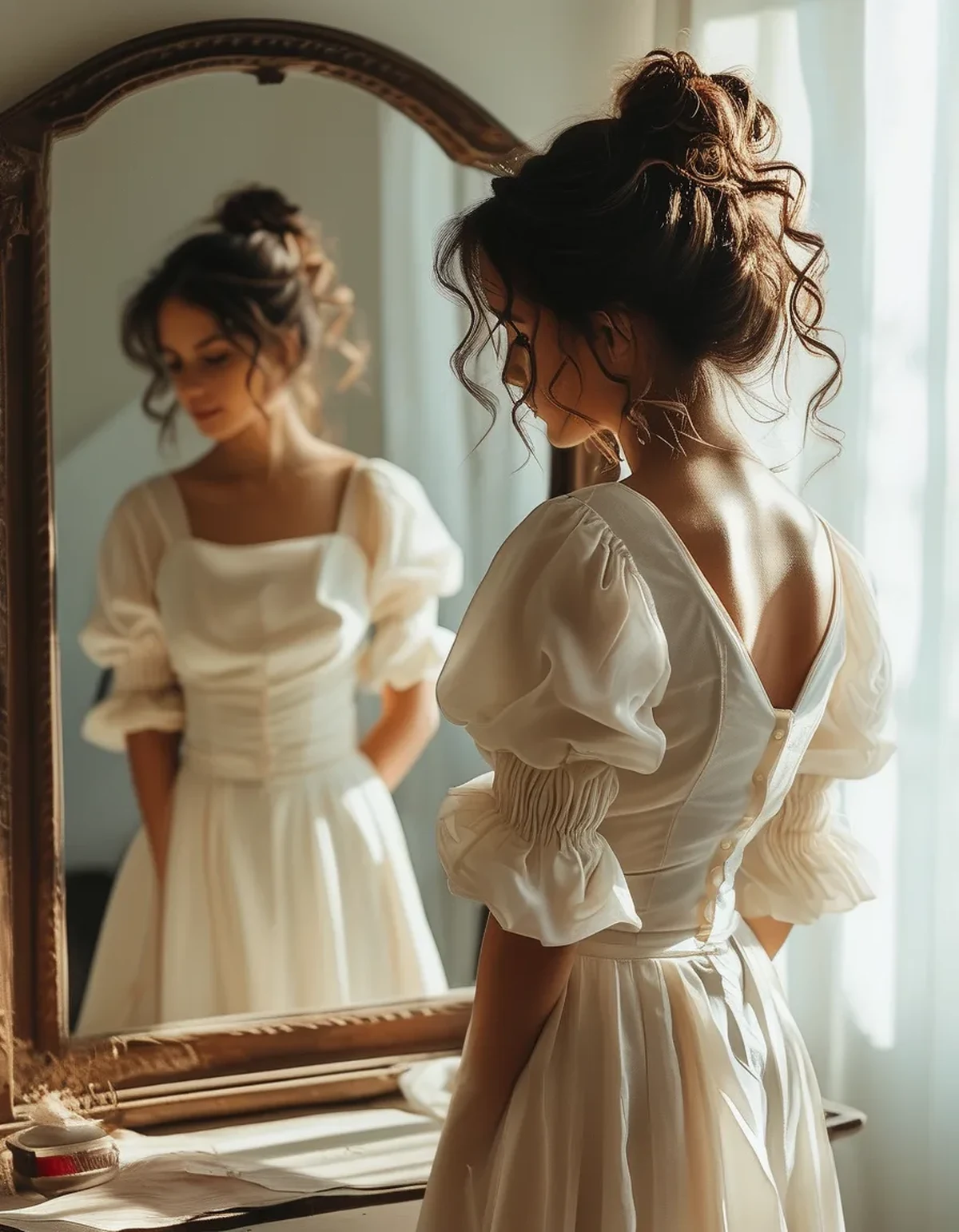
Elbow-length sits near the narrowest part of many torsos and tends to emphasize waist definition, since the line falls above the widest hip point.
Just-below-elbow (bracelet length) exposes the forearm’s narrowest section and reads as elongating, which is why it survives in tailoring across decades.
Natural-waist length reinforces waist placement strongly, so it works well with high-rise bottoms and can visually shorten the torso with low-rise ones.
High-hip length extends the visual torso downward and correspondingly shortens the perceived leg line — sometimes exactly what an outfit needs, often not.
Why does pushing sleeves up work so consistently?
Because it moves the horizontal to a spot that is almost always flattering: the narrowest part of the forearm, just below the elbow.
It also converts one strong horizontal into a softer, bunched transition rather than a hard line. A softened boundary reads as less segmenting than a crisp hem does, which is why a pushed-up sleeve on an otherwise unremarkable shirt reliably looks more considered. It’s a two-second adjustment that fixes both the placement and the hardness of the line at once.

5 Mistakes Everyone Makes With Sleeve Proportion
Mistake 1: matching sleeve hem to top hem. Two horizontals at nearly the same height stack into a heavy visual band. Stagger them.
Mistake 2: ignoring the sleeve when changing rise. Switching from mid-rise to high-rise bottoms changes where the waist line sits, which changes what the sleeve is doing relative to it.
Mistake 3: treating a three-quarter sleeve as universally safe. It’s safe on many frames, but on shorter arms it lands closer to high-hip and stops elongating.
Mistake 4: layering two sleeve lengths at the same point. A cardigan sleeve ending within an inch of the shirt sleeve creates visual noise. Either match exactly or separate clearly.
Mistake 5: buying for the photo. The fifth is the sneaky one — product shots are usually styled with the sleeve pushed or pinned, so the sleeve length you see isn’t the one arriving in the box.
How do you test this on your own clothes in five minutes?
Take one long-sleeve top and a mirror. Roll the sleeve to four positions — mid-forearm, just below elbow, at elbow, and full length — and photograph each from the same distance.
Looking at four photos side by side makes the difference obvious in a way live mirror-checking never does, because you’re comparing rather than judging in isolation. The position that looks best is your default, and it will hold across most tops with similar sleeve construction. That’s a repeatable rule from five minutes of work.
FAQ: Sleeve Proportion Questions, Answered
Does this change with different bottom silhouettes?
Yes. Wide-leg and straight-leg bottoms change where the eye expects the leg line to start, so a sleeve length that worked with slim bottoms may need adjusting.
What about sleeveless — does the armhole do the same thing?
It does, and armhole placement follows the same logic: the boundary creates a horizontal, just higher up, where it interacts with shoulder width instead of waist.
Can tailoring fix a sleeve length?
Sleeve shortening is one of the cheapest and most common alterations, and for a top you otherwise love it’s usually well worth it.
TL;DR:
- Sleeve hems create symmetric horizontals that the eye uses to segment the torso
- Just-below-elbow lands at the narrowest forearm point and reads as elongating
- Sleeve hem and top hem at the same height stack into a heavy band — stagger them
- Pushing sleeves up softens the line and relocates it in one move
- Photograph four roll positions once and you’ll have a default that holds for years
It’s the smallest adjustment in styling with the largest ratio of effect to effort. Five minutes, four photos, done.
Keep Reading
This article is for general informational and styling purposes only. Fit, sizing, and product availability may vary.