Why Two People the Same Height Need Different Hem Lengths
Quick Answer: Hem placement is set by leg length and where your knee sits, not by total height. Two women who are both 5’6” can differ by three inches in inseam because one carries more of her height in the torso. Measure your inseam and your knee height, then place hems relative to those landmarks: full-length trousers break at the top of the shoe, cropped styles land above the narrowest point of the calf, and midi hems sit either above or below the widest part of the calf, never on it.
You bought the same trousers as a friend who is your exact height. On her they skim the floor. On you they puddle. Nothing was mis-sized. You simply do not share the same distribution of that height.

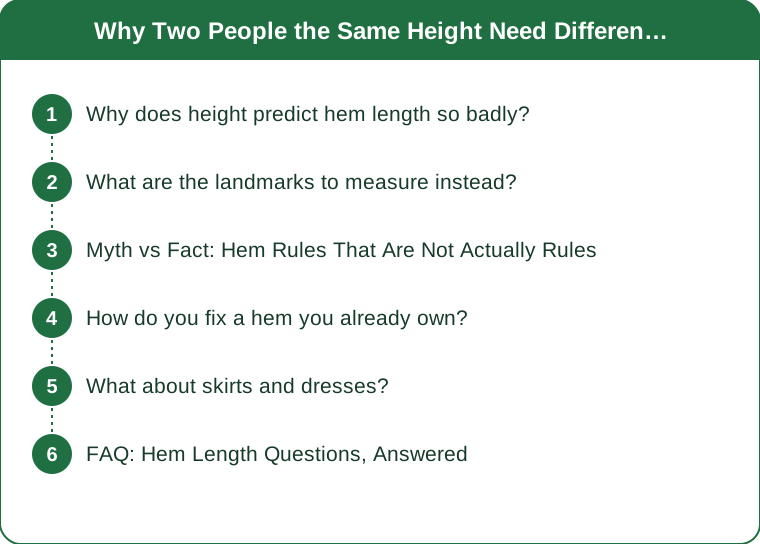
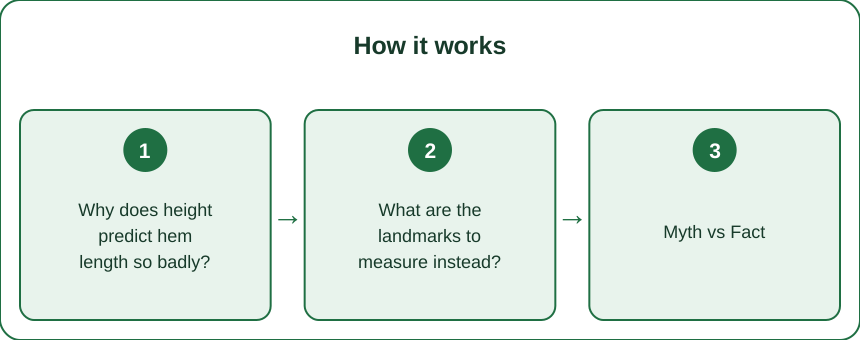
Why does height predict hem length so badly?
Because height is the sum of two independent measurements that vary a lot between people.
Your total height is torso plus legs, and the split is not fixed. Two women at 5’6” can easily have inseams of 29 inches and 32 inches respectively, which is a three-inch difference in exactly the dimension a hem cares about.
Brands grade by height bands because it is cheap and it is roughly right often enough. Regular, petite, and tall are height buckets, and they assume an average torso-to-leg split within each bucket. If you sit at the edge of that assumption, every pair of pants in your size will be wrong in the same direction, which is why the problem feels like a personal defect rather than a sizing convention.
The useful reframe: you are not a height, you are an inseam plus a rise. Once you shop by those two numbers, the frustration mostly disappears, and you stop buying the same wrong length repeatedly.
This is also why petite sizing fails for some short women. Petite shortens the rise and the inseam together. If you are short with long legs and a short torso, petite fixes your inseam and ruins your rise.
What are the landmarks to measure instead?
Four numbers, taken once, kept in your phone.
Inseam. From the crotch seam of well-fitting pants down to where you want the hem, measured on a garment laid flat rather than on your body. This is the most reliable number you own.
Knee height. From the floor to the middle of your kneecap. This tells you where a cropped hem will read as intentional versus accidental, because anything landing within an inch of the knee makes the leg look interrupted.
Calf width point. Stand sideways to a mirror and find the widest point of your calf, then measure its height from the floor. Hems that land exactly there add visible width; hems an inch or two above or below do not.
Ankle bone height. The classic reference for a cropped trouser or a straight jean. Landing just above the ankle bone reads as deliberate at almost any height.
With those four, hem decisions stop being guesswork. A midi skirt is not a length, it is a position relative to your calf, and the same 28-inch skirt is flattering on one person and awkward on another purely because of where their calf sits.
Myth vs Fact: Hem Rules That Are Not Actually Rules
Myth: Shorter people should always wear shorter hems. Fact: a shorter person with proportionally long legs often looks best in a full-length trouser that runs the line uninterrupted to the floor. What shortens the look is a hem that cuts the leg at a wide point, and that has nothing to do with height.
Myth: Cropped pants make you look shorter. Fact: cropped pants make you look shorter when they end at the widest part of the calf. End them at the narrowest point above the ankle and the effect reverses, because you expose the slimmest section of the leg.
Myth: A high waist always lengthens the leg. Fact: it lengthens the visible leg, which is a real effect, but if your torso is short a very high waist compresses the upper body and the overall line reads squat. Short torsos usually do better with a mid-rise plus a hem that runs long.
Myth: Wide-leg trousers need heels. Fact: they need length. A wide leg that reaches the floor works in flats. A wide leg that stops two inches short looks like an error regardless of the shoe, because the eye reads the gap rather than the line.
Myth: You should hem to your most-worn shoe. Fact: hem to your most-worn heel height, which is not the same thing. Shoes with the same heel height take the same hem, so one alteration covers a whole category rather than a single pair.
The one that surprises people most: the correct hem for a straight-leg jean and a wide-leg trouser in the same wardrobe is usually a full inch different, because a wider hem opening needs more length to hang properly without stacking.

How do you fix a hem you already own?
In order of cost, and the first two are free.
Change the shoe. Raising or lowering the heel by an inch shifts the entire relationship. A trouser that puddles in flats is often perfect in a low block heel, and this is the fastest test of whether length is really the problem.
Change where you break the waist. Tucking, half-tucking, or adding a belt moves the perceived leg start upward, which changes how the hem reads without touching the hem itself.
Cuff with intent. A cuff should land at a landmark, not wherever the fabric happens to fold. Cuff to just above the ankle bone or to the narrowest calf point, press it, and it reads as a design choice.
Hem properly. A tailor charge for a simple hem is small, and it is the single highest-return alteration in a wardrobe. Bring the shoes. Bring the exact shoes.
For jeans specifically, ask for an original-hem finish if the wash matters to you. It costs a little more, keeps the faded edge, and is the difference between a hemmed jean and a jean that looks hemmed.
And a rule that saves money: do not hem anything until you have worn it twice. Fabric relaxes, particularly in linen and heavier cotton, and a hem cut on day one is frequently a half inch short by month two.
What about skirts and dresses?
Same principle, different landmark, and the calf does most of the work.
The widest point of the calf is the position to avoid. A hem that lands there draws a horizontal line at your widest lower-leg measurement, which is why some midi skirts feel unflattering for reasons the wearer cannot name.
Above that point, roughly at the top of the calf just below the knee, is a length that works on most frames and reads as classic. Below that point, at the lower calf near the ankle, is the true midi and it is elegant on longer legs while it can shorten a shorter leg.
The knee itself is a second reference. Hems within about an inch of the kneecap tend to look accidental. Land clearly above or clearly below.
Boot height interacts with all of this. A skirt hem and a boot shaft that meet at the same height create a solid block; leaving two to three inches of visible leg between them keeps the line moving. That gap, not the skirt length, is what most people are actually reacting to when an outfit feels off.
For a maxi, the only real rule is that it should clear the floor when you walk and not when you stand still, which means about a half inch of clearance at the back with your usual shoe.
FAQ: Hem Length Questions, Answered
How do I find my inseam without help?
Take the best-fitting pants you own, lay them flat, smooth the leg, and measure from the crotch seam to the hem. That number is your inseam for that style. Do it for one straight leg and one wide leg, because they will differ.
Can a hem be lengthened?
Sometimes. Check the folded allowance inside the existing hem; a generous allowance can give you an inch or more, but the old crease may remain visible on dark or crisp fabrics. Steam and pressing help, though not always completely.
Why do the same size pants vary so much between brands?
Because each brand grades on its own fit model with its own torso-to-leg assumption. The size on the tag describes circumference reasonably well and length barely at all, which is why keeping your own inseam number beats trusting any size chart.
TL;DR:
- Height is torso plus legs, and the split varies enough that same-height people need different hems
- Measure inseam, knee height, widest calf point, and ankle bone height once and keep them
- Avoid landing hems on the widest calf point or within an inch of the knee
- Hem with the shoes you will actually wear, and wait two wears so the fabric settles first
Measure your best-fitting pair tonight and put the number in your phone. Every online order after that is a different experience.
See It in Motion
Seen here: High Waist Drawstring Wide Leg Yoga Pants with Pockets — shop it on bubblelime.com
Keep Reading
This article is for general informational and styling purposes only. Fit, sizing, and product availability may vary.